Cover

Simposio CEA de Robótica, Bioingeniería, Visión por Computador y Automática Marina 2026 · Bilbao · 10–12 June 2026

Oral presentation

Indirect Thermal-Aware Supervision for Agonist–Antagonist SMA Ankle Actuation

Sergio Jácobo-Zavaleta · Dorin Copaci · Sofía Die-Pancorbo · Dolores Blanco · Luis Moreno

Department of Systems Engineering and Automation · Universidad Carlos III de Madrid

SRAR Project · Soft Robotics for Ankle Rehabilitation · RoboticsLab

Motivation and control challenge

Compact actuation is attractive, but heat recovery limits endurance

Why SMA?
Lightweight, silent and compact actuation for early-stage ankle mobilization.

Main limitation
Heating is fast, but cooling is slow; repeated activation can produce heat accumulation.

Control challenge
Preserve closed-loop tracking while reducing unnecessary Joule heating.

Core idea

Do not only ask:

“How much should I track?”

Also ask:

When should energy enter the actuator?

Agonist–antagonist SMA Free cooling Thermal-aware supervision BPID tracking

The goal is not only accurate motion, but sustained tracking through control decisions that reduce unnecessary heating.

SYSTEM

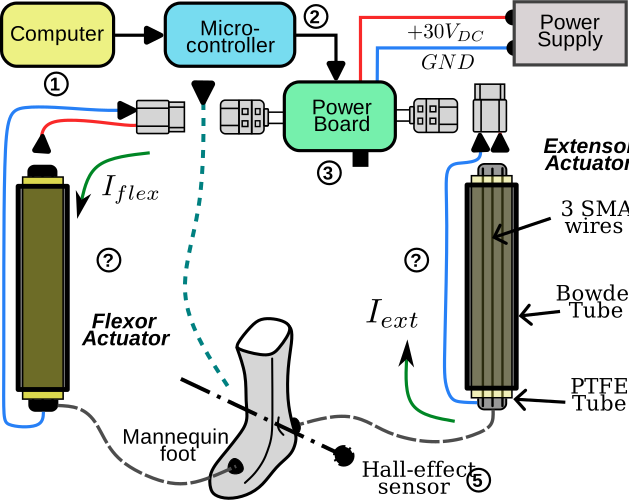
Antagonistic SMA ankle module

Actuation architecture

Hardware-in-the-loop Setup
  1. Host computer
  2. STM32F4 target
  3. Power electronics
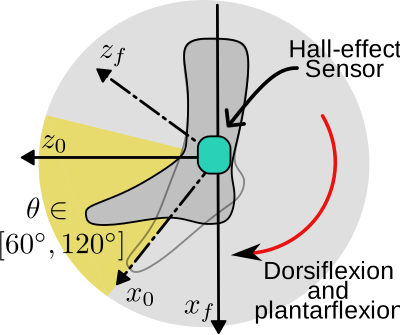
  4. Physical plant
  5. Position sensor

CONTROL

Tracking + thermal-aware supervision

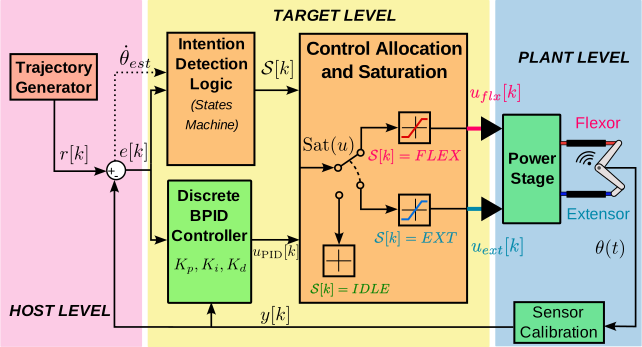
Closed-loop control scheme

A two-layer hierarchical logic executed across three layers.

The control scheme consists of:

Supervisory decision layer
Determines when each SMA group is allowed to receive Joule heating.

Bilinear PID layer
Computes how much control effort is applied to the active group.

The supervisor decides when to heat; the BPID decides how much.

State logic

State machine (motion intention and tracking error)
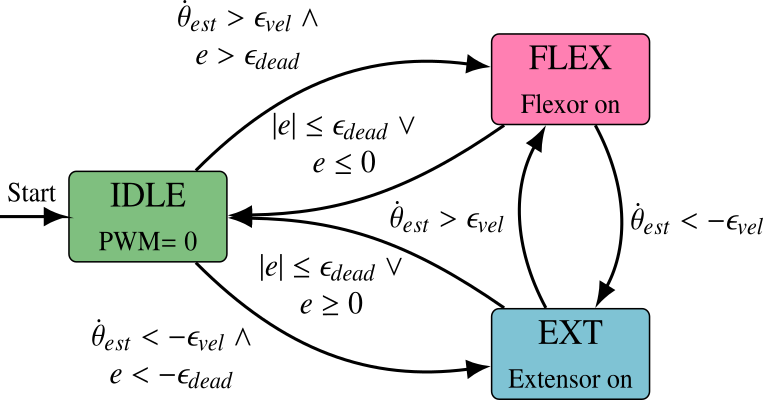
Supervisory flowchart

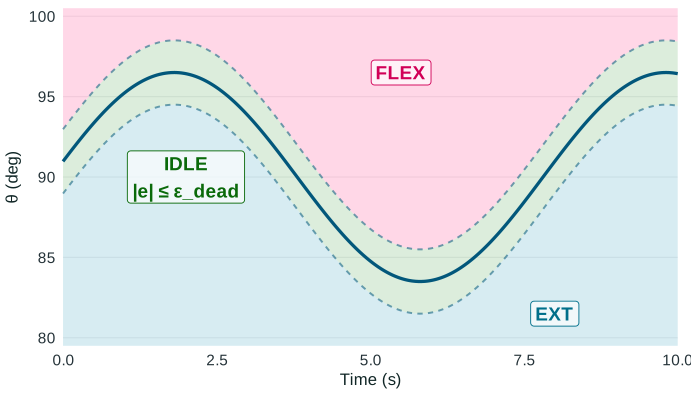
Conceptual plot of supervisory bands

Inside the band, the system stays in IDLE and exploits free cooling.

RESULTS

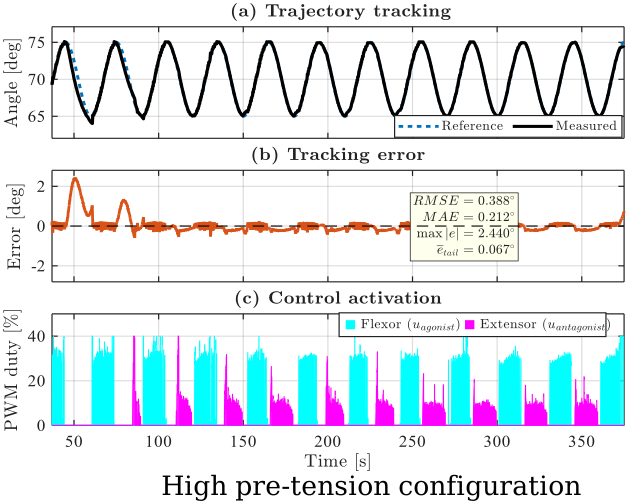
Results: configuration comparison

Lower backlash

RMSE = 0.388° · MAE = 0.212° · max \(|e|\) = 2.440°
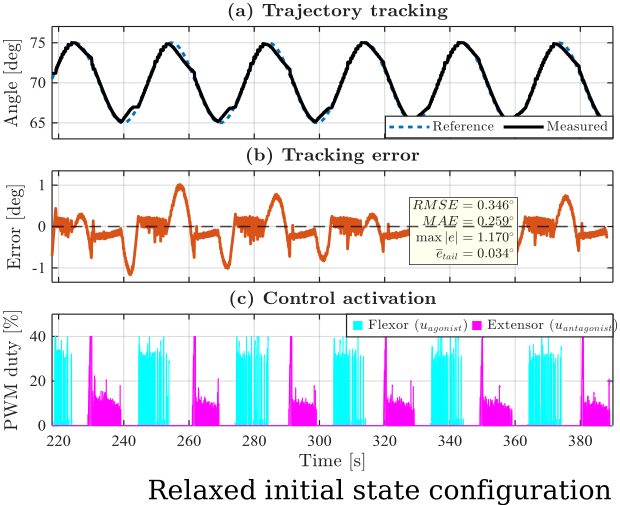
More passive compliance

RMSE = 0.346° · MAE = 0.259° · max \(|e|\) = 1.170°

High pre-tension improves early mechanical response, but the relaxed state reduces peak error and promotes recurrent free-cooling intervals.

Results: cyclic repeatability

The response remains consistent from cycle to cycle
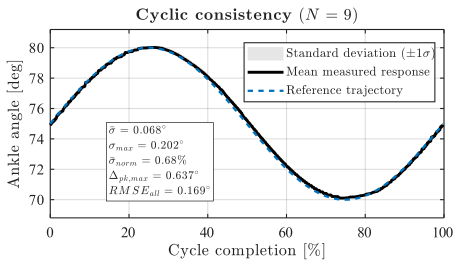
Low dispersion

Mean dispersion: \(\bar{\sigma}\) = 0.068°

Maximum dispersion: \(\sigma_{max}\) = 0.202°

Peak mismatch: \(\Delta_{pk,max}\) = 0.637°

Overall cyclic RMSE: RMSE\(_{all}\) = 0.169°

This indicates:

High repeatability Low inter-cycle drift Stable closed-loop behavior

The small dispersion band shows that tracking is not only accurate, but repeatable cycle after cycle.

Results: long-duration endurance

Stable operation over 40 minutes without thermal saturation
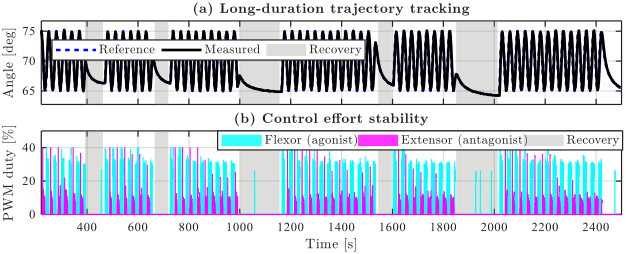
40-minute endurance

No persistent saturation

Recovery intervals No tracking collapse Closed-loop recovery

Duration
40 min closed-loop operation

Tracking accuracy
RMSE\(_{active}\) = 0.218°

Worst-case error
max \(|e|\) = 1.384°

Thermal behavior
Recovery intervals prevent persistent heat accumulation

The key result is sustained tracking: recovery windows are embedded in the control strategy, preventing persistent heat accumulation while keeping the loop active.

Discussion and take-home message

What do these results mean?

Tracking accuracy alone is not enough: in SMA systems, thermal recovery must be part of the control architecture.

The supervisor does not need direct temperature sensing. It uses motion intention and signed tracking error.

Inside the band, the controller stays in IDLE and exploits free cooling.

Take-home message
Indirect thermal-aware supervision enables SMA ankle actuation that is repeatable, sustained, and thermally robust.

Closing

Simposio CEA de Robótica, Bioingeniería, Visión por Computador y Automática Marina 2026 · Bilbao

Thank you

Discussion

Questions?

Indirect Thermal-Aware Supervision for Agonist–Antagonist SMA Ankle Actuation

Sergio Jácobo-Zavaleta · Dorin Copaci · Sofía Die-Pancorbo · Dolores Blanco · Luis Moreno

Universidad Carlos III de Madrid · SRAR Project · RoboticsLab