Indirect Thermal-Aware Supervision for Agonist–Antagonist SMA Ankle Actuation
Conference paper · 2026
Indirect thermal-aware supervision for antagonistic SMA ankle actuation
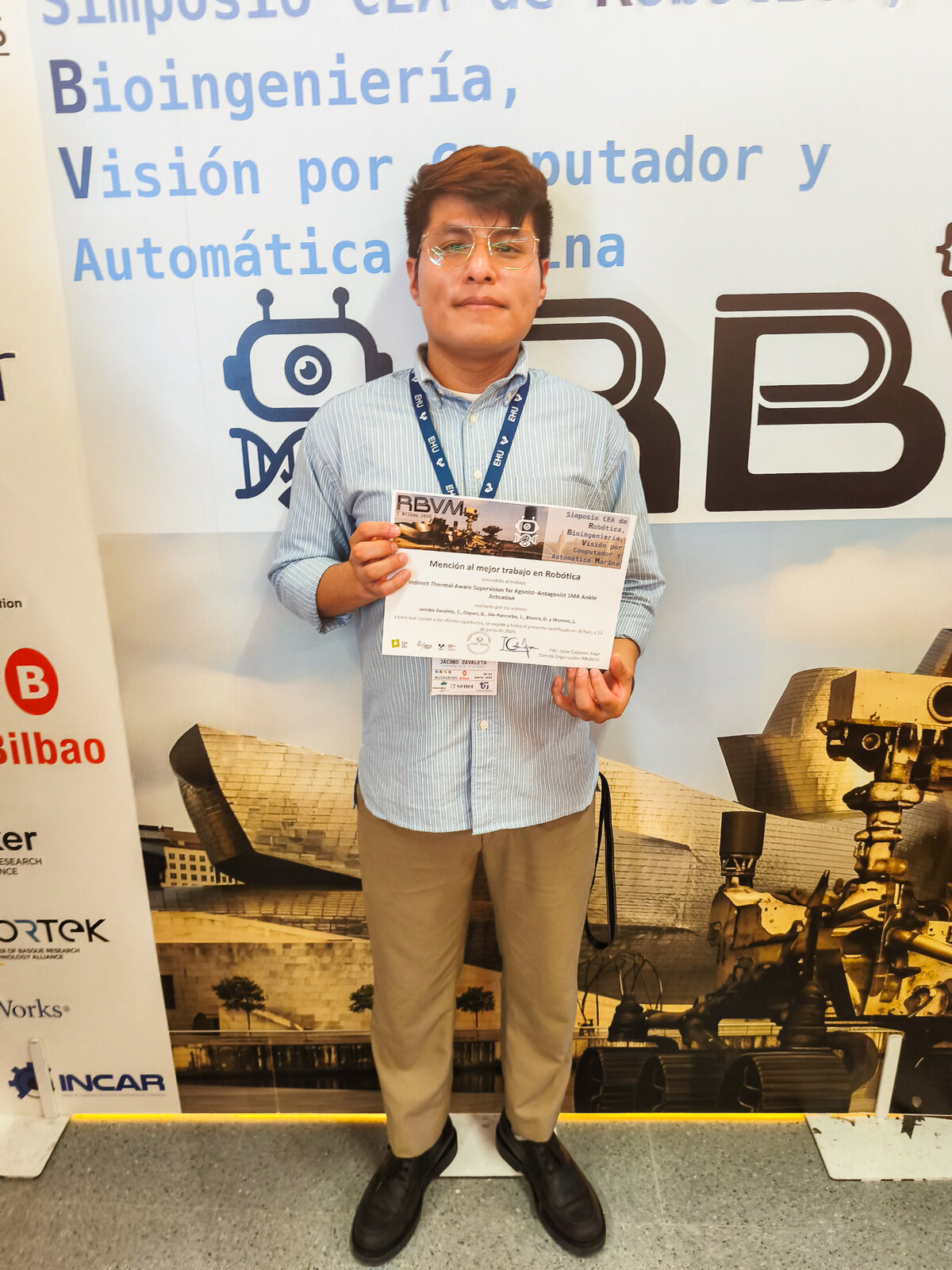
Best Paper Mention in Robotics · Bilbao 2026
Publication record
Authors: Sergio Jácobo-Zavaleta, Dorin Copaci, Sofía Die-Pancorbo, Dolores Blanco, and Luis Moreno
Proceedings: Simposios del Comité Español de Automática (CEA), 2(2)
Published: May 2026
DOI: 10.64117/simposioscea.v2i2.208
This work received a Best Paper Mention in Robotics at the 2026 CEA Symposium on Robotics, Bioengineering, Computer Vision, and Marine Automation in Bilbao.
Overview
The paper presents an indirect thermal-aware supervision strategy for a pair of antagonistic Shape Memory Alloy actuators integrated into a modular ankle rehabilitation platform. Because SMA contraction depends on heating and recovery, accurate angular tracking alone is not sufficient: the controller must also coordinate which actuator can be energized, which actuator should recover, and when the system should remain idle.
The proposed architecture combines a bilinear PID controller with a state manager that coordinates extension, flexion, and idle operation. This supervisory layer provides a practical way to incorporate thermal recovery into control decisions without depending on direct temperature feedback in the reported setup.
Contribution
- Agonist-antagonist SMA actuation applied to ankle mobilization.
- Indirect thermal-aware supervision through state-dependent activation and recovery.
- Experimental tracking and long-duration validation on the physical prototype.
- A control architecture designed around the limitations of the actuator rather than treating them as external disturbances.
Experimental perspective
The conference paper reports a global RMSE of 0.218° and MAE of 0.163°, calculated using the analysis window and processing available when the manuscript was prepared.
The work establishes a foundation for the larger validation framework now used in the master’s thesis. Subsequent analysis separates global tracking metrics, cyclic consistency, long-duration behavior, batch-wise trends, and controller-state statistics more explicitly. In the updated thesis analysis, the corresponding endurance dataset yields 0.220° RMSE and 0.167° MAE under its revised active-window definition.
These values come from different analysis stages. The thesis metrics update the research record but do not replace the results published in the Bilbao paper.
The reported evidence concerns the engineering prototype. It should not be interpreted as clinical validation.
Research context
This research forms part of Robótica blanda para la rehabilitación del tobillo (SRAR), R&D grant PID2023-149141OB-I00, funded by MCIN/AEI/10.13039/501100011033 and FEDER/EU.
BibTeX
@article{jacobozavaleta2026thermal,
  author  = {Jácobo Zavaleta, Sergio and Copaci, Dorin and
             Die-Pancorbo, Sofía and Blanco, Dolores and Moreno, Luis},
  title   = {Indirect Thermal-Aware Supervision for
             Agonist--Antagonist SMA Ankle Actuation},
  journal = {Simposios del Comité Español de Automática (CEA)},
  volume  = {2},
  number  = {2},
  year    = {2026},
  month   = {5},
  doi     = {10.64117/simposioscea.v2i2.208}
}Citation
@article{jácobo-zavaleta2026,
  author = {Jácobo-Zavaleta, Sergio and Copaci, Dorin and Die-Pancorbo,
    Sofía and Blanco, Dolores and Moreno, Luis},
  title = {Indirect {Thermal-Aware} {Supervision} for
    {Agonist–Antagonist} {SMA} {Ankle} {Actuation}},
  journal = {Simposios del Comité Español de Automática (CEA)},
  volume = {2},
  number = {2},
  date = {2026-05},
  url = {https://sjacobozavaleta.github.io/publications/entries/thermal-aware-sma-ankle-actuation/},
  doi = {10.64117/simposioscea.v2i2.208},
  langid = {en}
}